
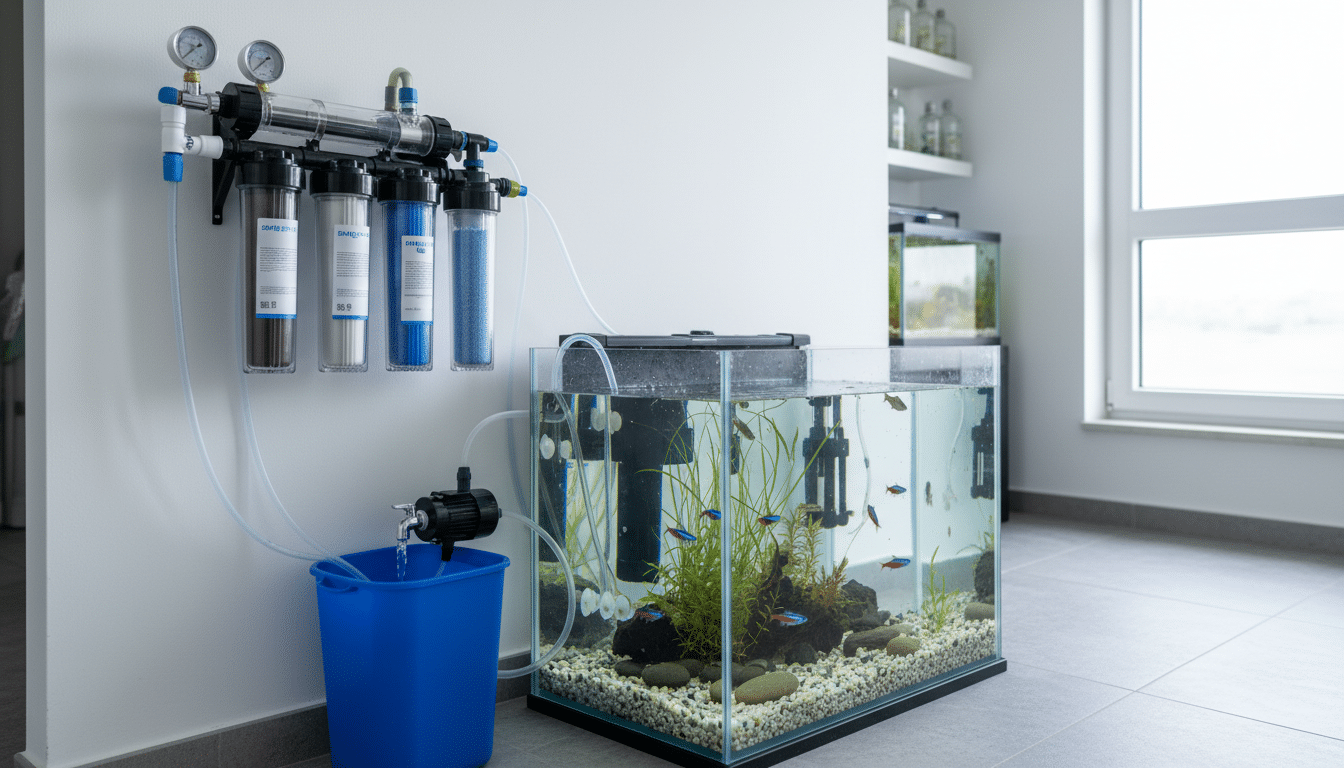
You’ve probably heard people swear by reverse osmosis water for fish tanks, while others seem to manage perfectly fine with tap water straight from the faucet. So what’s the real story? Let’s cut through the confusion and figure out whether RO water is actually worth your time and money.
What Makes Reverse Osmosis Water Different?
Reverse osmosis (RO) systems work like a super-fine sieve that removes nearly everything from your water except the H2O molecules themselves. We’re talking about filtering out minerals, chlorine, heavy metals, nitrates, phosphates, and even dissolved solids you didn’t know existed. The result? Water so pure it’s essentially a blank canvas with a TDS (total dissolved solids) reading close to zero.
Think of it this way: tap water is like a pre-seasoned dish, while RO water is like starting from scratch with raw ingredients. Sometimes you want that control, especially when dealing with sensitive species or specific breeding projects.
When You Actually Need RO Water in Your Aquarium
Here’s the thing most people don’t tell you: RO water isn’t universally necessary. If you’re keeping hardy community fish like guppies or platies, and your tap water parameters are decent, you’re probably fine as-is. But certain situations practically demand the precision that RO water provides.
Species That Demand Specific Water Chemistry
Some fish evolved in rivers and streams with extremely soft, acidic water. Wild-caught discus from the Amazon basin, for instance, naturally live in water with a GH (general hardness) of 1-3 and a pH around 5.0-6.5. Your municipal tap water probably reads more like GH 8-15 with a pH of 7.5-8.0. That’s a massive difference.
Crystal red shrimp are notoriously picky about TDS levels, preferring readings between 100-150 ppm. Many planted tank enthusiasts also swear by RO water because it lets them dose exactly the minerals and nutrients their plants need without competing ions interfering.
When Your Tap Water Is Genuinely Bad
I once met someone whose well water registered 400 ppm TDS with sky-high phosphate readings. No amount of water changes helped because they were literally pouring fuel for algae into their tank. After switching to reverse osmosis water, their chronic hair algae problem disappeared within three weeks.
If your municipality adds chloramines (harder to remove than regular chlorine), or if you’re dealing with heavy metals, agricultural runoff, or fluctuating parameters, RO water gives you consistency you can count on.
The Hidden Catch: RO Water Needs Remineralization
Here’s what catches people off guard: pure RO water is actually hostile to fish life. Zero TDS means zero buffering capacity, which leads to dangerous pH swings. It also lacks essential minerals like calcium and magnesium that fish need for bone development and osmoregulation.
You’ll need to add minerals back using remineralization products designed specifically for aquariums. Salty Shrimp, Seachem Equilibrium, and similar products let you target exact GH and KH (carbonate hardness) levels. This is where RO water becomes powerful because you’re essentially custom-blending water for your specific needs.
A 200-litre (53-gallon) tank housing Apistogramma dwarf cichlids might need RO water remineralized to GH 4, KH 2, with a pH of 6.5. Meanwhile, a Tanganyikan cichlid setup in the same sized tank would need remineralization to GH 10-12, KH 8-10, with a pH around 8.0. Same base water, completely different end results.
The Real Cost of Running an RO System
Let’s talk money because this matters. A decent RO unit runs between $150-400 for aquarium use. Budget units exist for under $100, but they typically waste more water and have shorter-lived membranes.
Speaking of waste water, here’s something to consider: most RO systems produce 3-4 litres (0.8-1 gallon) of waste water for every litre (0.25 gallons) of pure water created. Some people use this “waste” water for gardens or lawns, but if you’re in a drought-prone area or pay high water bills, this ratio adds up.
Replacement filters and membranes cost around $50-100 annually depending on your source water quality and usage. If you’re doing weekly 20% water changes on a 400-litre (106-gallon) tank, you’re producing 80 litres (21 gallons) of RO water weekly, which accelerates membrane wear.
Practical Tips for Using RO Water Successfully
Production speed is slower than you’d expect. Most aquarium RO units produce 190-285 litres (50-75 gallons) per day, which sounds great until you realize that’s 8-12 litres (2-3 gallons) per hour. Planning ahead becomes essential because you can’t just decide on Saturday morning to do a water change on your 300-litre (79-gallon) tank.
Storage containers become your best friend. Food-grade plastic barrels or dedicated RO water storage bins let you produce water in advance. I keep two 100-litre (26-gallon) containers: one for freshly made RO water awaiting remineralization, another for pre-mixed, temperature-matched water ready for changes.
Temperature matters more than people realize. Adding cold RO water directly to a tropical tank can shock fish, even if the chemistry is perfect. Mixing your water 24 hours in advance and storing it in the same room as your tank helps temperatures equilibrate naturally.
Mixing RO Water with Tap Water
Here’s a technique that saves money and time: blending RO and tap water instead of going 100% RO. If your tap water measures GH 12 and you need GH 6, mixing equal parts RO and tap gives you the ballpark figure you’re after.
This hybrid approach works brilliantly for moderately soft-water species. You’re still benefiting from contaminant removal while cutting your RO production needs in half. Just test your ratios carefully because tap water parameters can shift seasonally as treatment plants adjust their processes.
Alternatives Worth Considering
Not everyone needs a full RO system. Deionization (DI) units can polish already-decent tap water, removing dissolved solids without the waste water issue. They’re perfect if your tap water is close to target parameters but needs minor adjustment.
Some people collect rainwater, though this requires careful handling to avoid contamination from roof materials or air pollution. If you go this route, filtering through activated carbon and testing for pH, ammonia, and TDS becomes non-negotiable.
For small tanks under 100 litres (26 gallons), buying distilled or RO water from grocery stores might actually cost less than installing a home system. At roughly $1 per 4 litres (1 gallon), you’d spend about $5-8 per water change on a 75-litre (20-gallon) tank.
Common Mistakes That Waste Time and Money
The biggest error? Installing an RO system without first testing your tap water. I’ve seen people invest in equipment only to discover their tap water was already perfect for their chosen fish. Test kits are cheap insurance before making the RO leap.
Another gotcha: forgetting to adjust temperature and pH before water changes. Even if your chemistry is spot-on, adding 20°C (68°F) water to a 26°C (79°F) tank, or water with pH 6.0 to a stable pH 7.0 tank, creates stress that defeats the purpose of using quality water.
People also underestimate maintenance. Clogged pre-filters reduce RO efficiency and shorten membrane life. Swapping these inexpensive filters every few months saves the expensive membrane from premature failure.
Is RO Water Actually Worth It for Your Setup?
After keeping tanks for years, my honest take is this: reverse osmosis water for fish tanks solves specific problems beautifully but isn’t a universal requirement. If you’re breeding sensitive species, combating persistent water quality issues, or keeping demanding fish from extreme environments, RO water gives you control that’s nearly impossible to achieve otherwise.
But if your tap water tests reasonably well and matches your fish’s needs, you might be creating extra work without meaningful benefit. There’s no prize for making keeping fish harder than necessary.
The sweet spot? Start with your tap water parameters, identify what your specific fish actually need, then decide whether the gap between those two points justifies an RO system. Sometimes the answer is a clear yes, sometimes it’s definitely no, and sometimes it’s a practical maybe where a 50/50 blend solves everything.