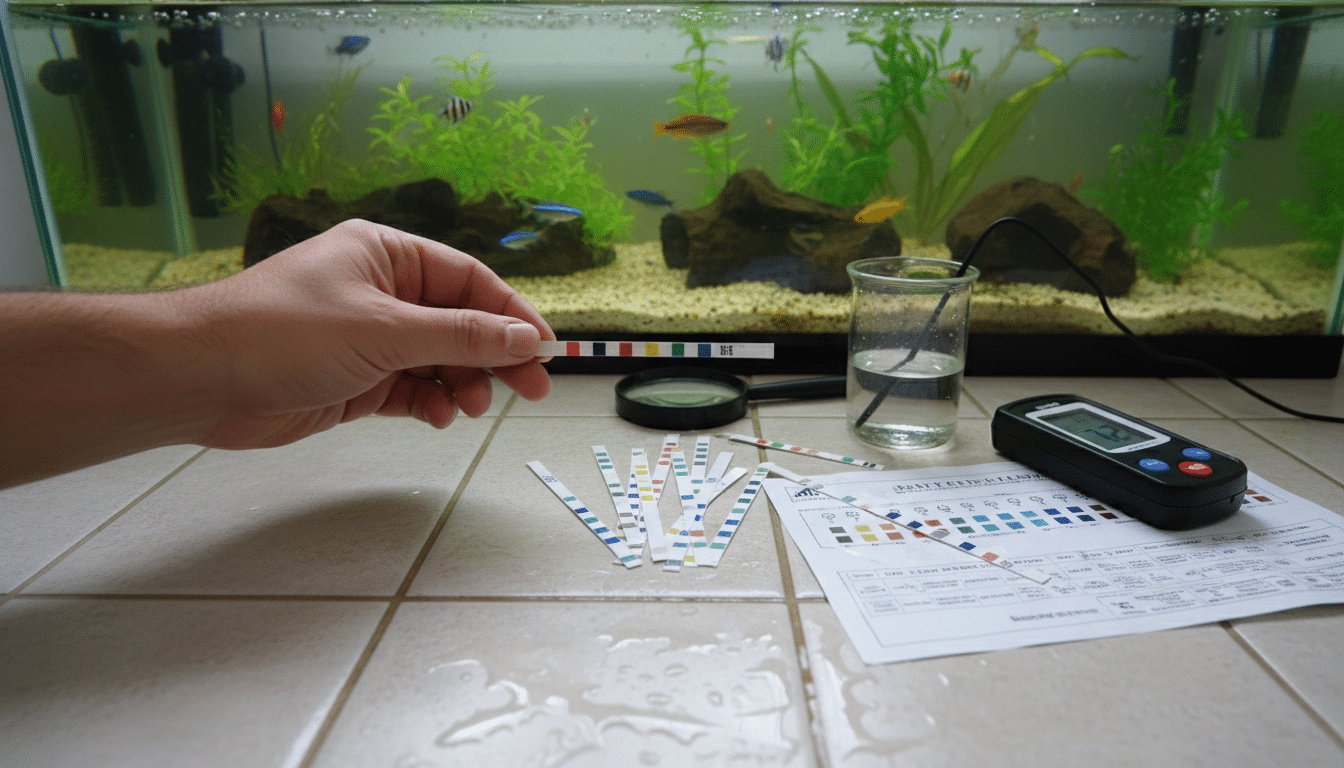
You’re standing there with a test strip in one hand and your phone in the other, trying to match those tiny colour squares to the chart on the bottle. Is that pink or light red? Does it matter that the strip is still a bit wet? And the real question burning in your mind: are these test strips actually telling me the truth about my aquarium water?
Let’s cut through the confusion and get you some straight answers. Test strips are one of the most popular ways to check water quality, but they’re also one of the most debated topics among people who keep fish. Some folks swear by them, others wouldn’t trust them as far as they could throw them, and most of us are somewhere in the middle trying to figure out what’s what.
The Honest Truth About Test Strip Accuracy
Here’s the deal: aquarium test strips are reasonably accurate when they’re fresh, stored properly, and used correctly. But notice all those conditions? That’s where things get interesting. Test strips typically have an accuracy range of plus or minus 10-20% compared to liquid test kits or laboratory-grade equipment, which might sound terrible until you realize that’s often good enough for everyday monitoring.
Think of test strips like checking your car’s fuel gauge. It might not tell you that you have exactly 38.7 litres (10.2 gallons) left, but it’ll definitely warn you when you’re running low. For most home aquariums, knowing your pH is around 7.0 rather than exactly 7.02 is perfectly adequate. The fish honestly don’t care about the second decimal place.
The real accuracy issues emerge when strips get old, exposed to humidity, or used improperly. A test strip that’s been sitting in your bathroom cabinet for two years? You might as well be reading tea leaves.
What Actually Affects Their Reliability
Storage conditions are the silent killer of test strip accuracy. Those little pads contain chemical reagents that react with substances in your water, and these reagents degrade when exposed to moisture, light, or heat. Opening your test strip bottle in a steamy bathroom after a hot shower basically starts a countdown timer on their usefulness.
The best test strips I’ve used came from bottles that were stored in a cool, dark, dry place and sealed immediately after each use. Some experienced folks even toss in a silica gel packet to absorb any moisture. It sounds fussy, but when you consider that a bottle of strips costs about the same as a decent coffee, protecting that investment makes sense.
User technique matters more than most people realize. The instructions say to dip for exactly one second, then remove and shake once. Not two seconds, not a gentle swirl in the water, and definitely not leaving it to soak while you answer a text message. Those precise instructions exist because the test pads are calibrated for specific reaction times.
Here’s something most people don’t know: the angle you hold the strip while reading it can actually affect the results. Looking at it straight on versus at an angle changes how light reflects off those colour pads, which can shift your reading by a whole level on the chart. Always hold the strip flat and view it from directly above in good lighting.
Which Parameters Can You Actually Trust?
Not all test strip readings are created equal. Some parameters are measured more reliably than others, and understanding this helps you know when to double-check with a liquid test kit or professional analysis.
pH readings on test strips are generally pretty solid, usually within 0.2-0.5 units of the actual value. Since pH operates on a logarithmic scale, even this margin keeps you in the right ballpark for most fish. Your community tank inhabitants won’t notice the difference between 7.0 and 7.2, though sensitive species breeding setups might need more precision.
Hardness measurements including both general hardness (GH) and carbonate hardness (KH) tend to be fairly reliable on test strips. These tests use colour changes that are distinct enough to read without squinting, and the ranges provided are broad enough that slight variations don’t cause problems. If your strip says your water is hard, it’s probably hard.
Nitrate readings are where test strips start getting sketchy. The colour differences between 20 ppm and 40 ppm can be maddeningly subtle, especially under artificial lighting. Many strips also stop at 160-200 ppm, which isn’t helpful when dealing with serious water quality issues. If you’re troubleshooting a problem or setting up a new tank, liquid tests for nitrates are worth the extra effort.
Nitrite testing on strips is perhaps their weakest point. The colour changes can be ambiguous, and this is one parameter where precision matters enormously. Even 0.5 ppm of nitrite is toxic to fish, but test strips often struggle to distinguish between zero and low-level readings. During cycling or after adding new fish, I’d never rely solely on strips for nitrite.
Ammonia test strips exist, though they’re less common on multi-parameter strips. When they do appear, they’re typically the least reliable reading on the whole strip. Ammonia is another parameter where zero and any detectable amount represent vastly different situations for your fish’s health.
When Test Strips Make Perfect Sense
Despite their limitations, test strips absolutely have their place. For routine maintenance checks on an established, stable aquarium, strips are brilliant. You can test weekly in about thirty seconds, and you’re really just confirming that nothing has gone sideways since last time. It’s the water quality equivalent of a quick wellness check.
They’re also fantastic for testing multiple tanks efficiently. If you’ve got three or four aquariums running, breaking out liquid test kits for each one every week becomes a real time commitment. Test strips let you quickly screen all your tanks and then follow up with detailed testing only on anything that looks off.
Travel situations make test strips shine. Whether you’re at a pet shop looking at a display tank before buying fish or visiting a friend who needs help with their aquarium, having test strips in your bag is more practical than carrying bottles of liquid reagents around.
When You Should Absolutely Use Something Better
Cycling a new aquarium demands better accuracy than strips typically provide. You need to track ammonia and nitrite with precision because you’re watching for specific patterns and timing. The difference between 0 ppm and 0.25 ppm nitrite tells you whether your cycle is complete or still processing, and that’s not a distinction test strips handle well.
Diagnosing fish health problems requires real numbers, not approximations. If your fish are showing stress, lethargy, or disease symptoms, you need to know exactly what’s happening with your water chemistry. This isn’t the time to wonder if that colour is “close enough” to the chart.
Breeding sensitive species or keeping high-value fish means precision matters. When you’re trying to create exact conditions for Discus or working with expensive rare species, the 10-20% accuracy margin on test strips becomes significant. These situations justify investing in better testing equipment.
Working with very soft or very hard water can push test strips outside their optimal range. Many strips are calibrated for typical tap water parameters, so if you’re working with RO water, extremely hard well water, or specialized setups, the colour charts might not have enough granularity where you need it.
Making Test Strips Work Better For You
If you’re going to use test strips, and honestly most of us do, here’s how to get the most accurate results possible. First, always buy from retailers with good turnover so you’re getting fresh strips. Check the expiration date before buying and don’t stock up on that amazing sale if you won’t use them within six months.
Store your strips somewhere truly dry and cool, not just anywhere convenient. The kitchen drawer near the sink? Terrible. The cabinet above the aquarium where warm, humid air rises? Also terrible. A drawer in your bedroom or a cupboard away from water sources works much better.
When you test, set a timer on your phone for the exact waiting period specified. Most strips say to read results at 60 seconds, and that’s not a suggestion. Reading too early or too late genuinely affects the accuracy because the chemical reactions are still developing or starting to fade.
Consider keeping a small notebook or using a phone app to track your readings over time. Patterns matter more than individual numbers, and tracking lets you spot trends. If your pH is gradually dropping or your nitrates are slowly climbing, that tells you something important even if the individual readings aren’t laboratory-precise.
The Hybrid Approach That Actually Works
Here’s what works for most people: use test strips for regular monitoring and liquid tests for critical parameters or problem-solving. Keep a good liquid test kit for ammonia, nitrite, and nitrate, then use strips for your weekly pH and hardness checks. You get convenience where it makes sense and accuracy when it matters.
For established tanks running smoothly, monthly detailed testing with liquid kits combined with weekly strip tests catches problems early without becoming a second job. New tanks or those with issues need liquid testing weekly until everything stabilizes.
Some folks take water samples to their local fish shop for free testing every few months as a calibration check. If your strips have been saying everything is fine but the shop’s tests reveal problems, you know it’s time for fresh strips or better technique.
What The Numbers Actually Mean For Your Fish
Understanding whether your test results are “close enough” requires knowing what actually matters to your fish. Most common community fish are remarkably adaptable to a range of conditions. A pH anywhere from 6.5 to 7.5, moderate hardness, and low nitrates gives them a comfortable home. The precision of laboratory testing is overkill for these situations.
But parameters like ammonia and nitrite operate on a different scale. The difference between 0 ppm and 0.25 ppm ammonia is the difference between safe and toxic, which is why test strips struggle here. These are binary situations: either you have zero or you have a problem.
Temperature stability often matters more than hitting exact numbers. Fish adapt to stable conditions within their range far better than they handle constant fluctuations, even if those fluctuations keep the water technically “correct” for the species. Test strips won’t tell you about temperature, but this context helps you prioritize what accuracy you actually need.
The Bottom Line On Strip Accuracy
So are fish tank test strips accurate? The answer is yes, with caveats. They’re accurate enough for routine monitoring of established tanks when fresh and properly used. They’re not accurate enough for critical situations, troubleshooting problems, or monitoring new tank cycling. They work brilliantly as a first-line screening tool but shouldn’t be your only testing method.
Think of test strips as the smoke detector in your home. It won’t tell you the exact temperature of a fire or the precise concentration of smoke particles, but it’ll definitely warn you when something is wrong. For that purpose, it’s perfectly adequate and far better than checking nothing at all.
The real key is understanding their limitations and using them appropriately. Keep fresh strips for weekly checks, maintain liquid test kits for detailed analysis when needed, and you’ll have the best of both worlds. Your fish care about stable, safe water conditions far more than they care about whether you measured those conditions with strips or laboratory equipment.
Most importantly, consistent testing with any method beats occasional testing with perfect accuracy. The person who checks their water weekly with test strips will catch problems faster than someone who only breaks out the liquid kits once a month. Use the tools you’ll actually use regularly, and your fish will be just fine.