Let me tell you about one of the most bulletproof plants you’ll ever put in your aquarium. Anubias aquarium plants are the kind of addition that makes you look like you know what you’re doing, even if you’re still figuring out the difference between your filter intake and output.
These West African natives have earned their reputation as the go-to plant for beginners and experienced tank keepers alike. Why? Because they’re remarkably forgiving, genuinely attractive, and virtually impossible to kill unless you’re really trying. If you’ve ever watched other aquarium plants melt away within days of bringing them home, Anubias will feel like a breath of fresh air.
What Makes Anubias Different From Other Aquarium Plants
Here’s something most people don’t realize: Anubias are actually semi-aquatic plants in the wild. They grow along riverbanks and streams in places like Cameroon and Nigeria, spending part of their time above water. This explains why they’re so darn resilient in your tank, they’ve evolved to handle both submerged and emerged conditions.
The thick, waxy leaves you see aren’t just for show. That leathery texture serves as armor against hungry fish that would normally treat softer plants like a salad bar. Goldfish, cichlids, and even those nippy barbs tend to leave Anubias alone, which is a huge advantage if you’re trying to create a planted tank with less-than-plant-friendly residents.
Another fascinating quirk? Anubias have one of the slowest growth rates among aquarium plants. While this might sound like a disadvantage, it actually means they need almost zero maintenance. You won’t be trimming them every week like you would with stem plants, and they won’t take over your tank while you’re on holiday.
Popular Anubias Varieties Worth Knowing
Walk into any decent aquarium shop and you’ll typically find Anubias barteri and its variants. This is the workhorse of the Anubias world. The variety Anubias barteri var. nana (often just called Anubias nana) stays compact at around 5-10 cm tall, making it perfect for smaller tanks or foreground placement.
If you want something with real visual punch, check out Anubias barteri var. coffeefolia. The leaves have this incredible quilted, rippled texture that looks like someone took regular Anubias and gave them character. They’re slightly larger and create beautiful focal points when attached to driftwood.
For nano tanks, Anubias nana petite is your friend. We’re talking leaves that stay around 2-3 cm, perfect for those small desktop aquariums where proportion matters. And on the opposite end, Anubias gigantea can reach up to 30 cm tall, though you’ll need a reasonably sized tank to showcase it properly.
The Rare and Unusual Varieties
If you’ve caught the Anubias bug, you might eventually stumble across Anubias congensis with its distinctly pointed leaves, or Anubias gracilis with narrow, almost grass-like foliage. These aren’t as common, but they offer variety if you’re building a collection or want something a bit different from the standard broad-leafed types.
Setting Up Your Tank for Anubias Success
Here’s where Anubias really shine. They tolerate a huge range of water parameters. We’re talking 22-28°C (72-82°F), pH anywhere from 6.0 to 8.0, and they don’t particularly care whether your water is soft or hard. This flexibility means they work in almost any community tank setup without demanding special treatment.
Lighting is where beginners often overthink things. Anubias prefer low to moderate light, which translates to about 1-2 watts per gallon in old-school terms, or 20-40 PAR if you’re using modern LED metrics. Too much light and you’ll face the one real enemy of Anubias: algae growing on those beautiful leaves. Since the leaves grow so slowly, algae can colonize them faster than the plant can replace damaged tissue.
You don’t need CO2 injection or fancy fertilizers. Seriously. Anubias pull nutrients from the water column through their leaves and roots, and they’re efficient enough to work with whatever’s naturally present in a stocked tank. That said, they won’t complain if you do add liquid fertilizers, particularly ones with micronutrients like iron that keep the leaves vibrant and green.
The Critical Planting Mistake Everyone Makes
Pay attention to this bit, because it’s the single most common way people accidentally kill their Anubias. Never bury the rhizome in substrate. That thick, horizontal stem where all the leaves and roots sprout needs to stay exposed to water flow. Bury it, and you’re basically inviting rot to set in.
Think of the rhizome like the plant’s spine. Everything grows from it, and it needs oxygen circulation. When you cover it with gravel or sand, you create an anaerobic environment where beneficial bacteria can’t reach it, but harmful ones can. Within weeks, you’ll notice the rhizome turning mushy and brown, and by then it’s usually too late.
So how do you actually plant Anubias? You don’t plant them in the traditional sense at all. You attach them to hardscape.
Attaching Anubias to Driftwood and Rocks
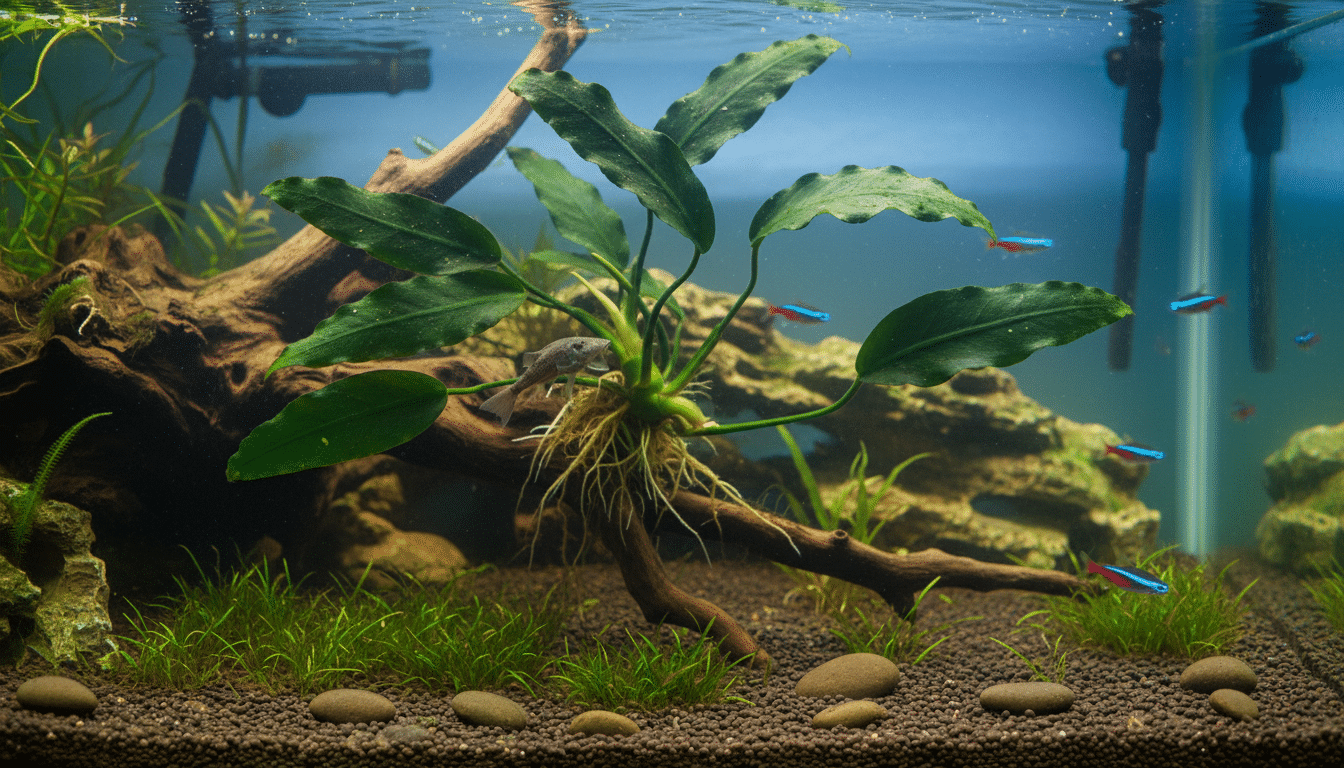
The easiest method involves fishing line, cotton thread, or specialty plant glue. If you’re using thread, simply tie the rhizome to a piece of wood or rock, keeping the knots snug but not tight enough to cut into the plant tissue. Within 2-4 weeks, the roots will naturally grip the surface, and you can carefully remove the thread if you want (though leaving it is fine, it’ll eventually decompose).
Cyanoacrylate gel glue (the thick superglue you can find at hardware stores) works brilliantly and is aquarium-safe once cured. Pat the rhizome dry with a paper towel, apply a small dab of glue, and press it firmly against your chosen surface for about 30 seconds. The plant will be permanently attached, and the roots will grow over the glue spot anyway.
Here’s a neat trick: attach Anubias to the shadier sides of large rocks or on the back portions of driftwood branches. This gives them the lower light they prefer while creating a more natural appearance, like you’d see in a riverbed.
Dealing With Anubias Melt and Common Issues
Sometimes you’ll bring home a beautiful Anubias only to watch older leaves turn yellow and eventually transparent within the first few weeks. This is typically transition melt, and it’s not necessarily a death sentence. Plants grown emerged (above water) at nurseries need time to convert to submerged leaf forms. The old leaves die back while new, water-adapted leaves emerge from the rhizome.
The best response? Patience. Trim off the dying leaves close to the rhizome with clean scissors to keep your water quality stable, and give the plant time to adjust. As long as the rhizome stays firm and you see new growth poking through, you’re fine.
Algae on leaves is your other main challenge. Those slow-growing leaves are basically billboards for algae if your lighting is too strong or your tank has excess nutrients. Brown diatoms, green spot algae, and black beard algae all love to set up shop on Anubias leaves. Prevention beats treatment here: keep lighting moderate, maintain good water circulation around the leaves, and consider adding algae-eating crew members like nerite snails or otocinclus catfish.
If algae does establish, you can remove affected leaves entirely or try spot-treating with liquid carbon products. Some people remove the whole plant temporarily and give it a quick dip in diluted hydrogen peroxide (1 part 3% peroxide to 10 parts water for about 90 seconds), but this is aggressive and risks damaging the plant if done incorrectly.
Propagation: Growing Your Anubias Collection
Want more Anubias without spending more money? The rhizome division method is straightforward. Wait until your plant has at least 5-6 leaves and a healthy rhizome that’s several centimeters long. Using a sharp, clean blade or scissors, cut the rhizome between leaf clusters, making sure each section has at least 3 leaves and some roots attached.
Both pieces will continue growing as independent plants. The cut surfaces might look a bit rough initially, but they’ll heal on their own. Just make sure your cutting tool is clean to avoid introducing bacteria into the wounds.
Here’s something interesting: Anubias can flower underwater. You might one day notice a white, hood-shaped bloom emerging on a long stem. It’s not the most spectacular flower in the plant world, but it’s a neat sign that your plant is genuinely happy. These flowers can actually produce seeds, though growing Anubias from seed is painfully slow and not practical for most people.
Tank Mates and Aquascaping Ideas
Anubias pair wonderfully with fish that need visual barriers and hiding spots. Cichlids from Lake Malawi or Tanganyika, for instance, appreciate the tough leaves and the territory-defining structure Anubias create when attached to rocks. South American cichlids like rams and apistos look natural swimming around Anubias-covered driftwood that mimics their native rivers.
For peaceful community tanks, consider creating an Anubias forest by attaching multiple plants to a large piece of branching driftwood. The different heights and leaf angles create depth, and the contrast between the dark green leaves and brown wood is visually striking. Add some moss to the wood between Anubias clusters, and you’ve got an aquascape that looks professional with minimal effort.
In paludariums (half-land, half-water setups), Anubias really show their versatility. You can position them right at the waterline where they’ll grow both submerged and emerged leaves, or keep them fully above water where they’ll develop thicker, more rigid foliage. The emerged growth often looks healthier and more vibrant, plus you’re more likely to see those unusual white flowers.
Why Anubias Deserve a Spot in Your Tank
If you’re still on the fence, consider this: a single Anubias plant can last for years, potentially outliving the fish in your tank. They don’t demand expensive equipment, complicated fertilizing schedules, or constant attention. They add genuine beauty through simple, elegant foliage that complements rather than overwhelms your aquascape.
For beginners, they offer success without the steep learning curve of demanding plants. For experienced tank keepers, they provide reliable greenery that anchors more complex aquascapes. And for anyone dealing with plant-eating fish, they’re often the only option that survives long-term.
The slow growth that might seem like a drawback is actually liberating. Your aquascape stays relatively stable. You’re not constantly trimming and replanting. You can actually enjoy your tank rather than constantly maintaining it. In a hobby where things can feel overwhelming, especially when you’re starting out, Anubias represent the kind of straightforward success that keeps people engaged.
So whether you’re setting up your first 40-litre (10-gallon) tank or planning an ambitious 400-litre (100-gallon) planted community, Anubias aquarium plants deserve serious consideration. They’re the reliable friends in a hobby where not everything goes according to plan, and honestly, we could all use more of those.